
One Cup, Four Systems: How Tea, Milk, Fruit and Syrup Ratios Make or Break a Fruit Tea
Four systems meet in a fruit tea, and they do not want the same thing. Tea carries astringency and body. Milk carries protein and fat. Fruit carries acid and aroma. Syrup carries sweetness and density. Get the ratios right and the drink reads as one thing. Get them wrong and every sip announces which system won.
Sixteen years of formulation work on the supply side leaves you with a way of reading a cup. What follows is how we break down every fruit tea and fruit milk drink that crosses our bench, ingredient by ingredient, with the numbers we actually use.
Key takeaways
- A fruit tea is four systems negotiating inside one cup. The recipe is the terms of the deal.
- Acid and milk protein are natural enemies. Casein loses its electrical charge near pH 4.6. Most fruit purees sit between pH 3.0 and 3.8. Fresh milk meeting high-acid fruit curdles. A stabilised milk base or creamer does not.
- The most expensive failure is delayed. A drink can sit just above pH 4.6, look perfect leaving the shaker, and split ten minutes later as the ice melts and the cup warms up.
- Tea in a fruit tea runs one notch lighter than most operators pour. Over-strong tea buries the fruit aroma, fights the milk protein, and turns bitter over ice.
- Syrup is a density dial as much as a sweetener. The number that matters is brix against acid, and the sugar already inside your jam has to be counted.
- Layered fruit milk drinks are built physics. Pour order and density decide whether the customer sees marble or mud.
Who is writing this
Sixteen years of formulation work leaves you with a set of habits. I test every recipe twice, once in the lab and once in the worst kitchen the client owns. I read a pH meter before I read a recipe card. And I keep a folder of photographs of curdled drinks, because every one of them cost somebody money.
The habit came from a mistake of mine. In 2018 I signed off a passion fruit milk tea after testing it in a 300 ml beaker in an air-conditioned lab. It looked flawless. Day three of production, in a kitchen running at 34 degrees, the batches started splitting on the counter ten minutes after shaking.
The recipe was right. The conditions were not. We rebuilt the drink on a stabilised creamer base, and I learned where recipes actually live: not on paper, but in the gap between a beaker and a real counter.
Part 1: The tea base carries the skeleton
In a fruit tea, the tea is the skeleton.
Fruit aroma is mostly volatile. It sits in the top of the cup and it fades. What holds the drink together, what stops it reading as fruit-flavoured sugar water, is the structure the tea brings: astringency, body, and the slight dryness on the finish that makes the next sip welcome.
That structure has a working window, and in a fruit tea the window sits lighter than most operators pour. On our bench, fruit tea bases run about one notch lighter than plain milk tea bases: a green or light oolong steeped near 1:50 at around 70 degrees, against a heavier pull for a drink where the tea is the point. We publish the selection logic separately in our guide to choosing a jasmine green tea base, and the wider range sits on our tea base page.
The reason is arithmetic as much as taste. A full cup of ice dilutes the finished drink by 25 to 35 percent, so you over-extract slightly to compensate. Past that point you are feeding three problems at once.
Over-strong tea in a fruit tea does three kinds of damage. It buries the fruit aroma under tannin. It complexes with milk protein and leaves a dry, skin-like film on the tongue. And tannin reads more bitter cold than warm, so the tea that tasted balanced in the tasting cup turns harsh by the last third of the drink.
There is also the cold-cloud problem. Heavier black tea bases throw a haze when chilled, a polyphenol complex that clouds the cup and muddies bright fruit colour. This is why most fruit teas lean on jasmine green, four seasons spring oolong or a light tie guan yin, and why a dark roasted base belongs in a milk tea, rarely in a fruit tea.
Table A. The four systems at a glance, and what imbalance looks like
| System | What it contributes | When it is over | When it is under |
|---|---|---|---|
| Tea base | Astringency, body, a skeleton for the aroma | Bitter over ice, tannin buries the fruit, dries against milk | Sugar water with no spine |
| Milk or creamer | Protein, fat, smoothness, colour | Fills the cup, fruit disappears, curd risk climbs | Thin finish, no body |
| Fruit or jam | Acid, aroma, colour, visible evidence | Acid attacks the milk, sugar overruns the target, colour dulls | Hollow flavour, powder drink |
| Syrup | Sweetness, body, density | Masks aroma, sinks to the bottom, label trouble | Sour read, thin texture |
What to do:
- Run your fruit tea base one notch lighter than your plain milk tea base, and compensate for ice dilution deliberately rather than by instinct.
- Keep green and oolong bases under about 75 degrees. Heat is what pulls the tannin you do not want.
- Match the tea to the fruit. Light bases with bright fruit, and never let a roasted base fight a mango.
- If the cup clouds after chilling, the tea is too heavy for the job. Change the base, do not add more syrup.
Part 2: The milk system is where recipes go to die
Milk in a fruit drink is a protein suspension looking for an excuse to collapse.
The chemistry takes one paragraph. At milk's natural pH of 6.6 to 6.8, casein micelles carry a net negative charge, so they repel each other and the milk pours smooth. Acidify toward pH 4.6 and that charge disappears. The proteins stop repelling, collide, clump and rise as curd. That number, 4.6, is the isoelectric point of casein, and it is the most expensive number in this category.
Now the other side of the equation. Fresh fruit is acidic by nature. Passion fruit runs pH 2.8 to 3.2. Strawberry sits at 3.0 to 3.5. Pineapple is 3.2 to 3.5, with the bonus problem of bromelain, an enzyme that digests protein directly. Mango swings between pH 3.4 and 4.8 depending on ripeness, which means the same cultivar can be safe with fresh milk in August and curdle it in October.
Table B. Fruit acidity and the risk it carries for a fresh-milk build
| Fruit | Typical pH | Fresh-milk risk | Note |
|---|---|---|---|
| Lemon, lime | 2.0 to 2.6 | Very high | Effectively no fresh-milk recipe |
| Passion fruit | 2.8 to 3.2 | Very high | The most common curdling complaint in the trade |
| Strawberry | 3.0 to 3.5 | High | Worse out of season, when acidity climbs |
| Pineapple | 3.2 to 3.5 | High, plus enzyme | Bromelain digests protein; heat treatment reduces it |
| Mango | 3.4 to 4.8 | Depends on ripeness | Can swing close to a full pH unit across a season |
| Peach | 3.3 to 3.6 | Moderate | Workable with fresh milk if cold and fruit goes in last |
Three routes survive this.
Route one: low-acid fruit with fresh milk. Ripe mango, peach, banana. It works with cold ingredients and the fruit added last. It is a menu item, not a platform.
Route two: a stabilised milk base. The trade solved this decades ago for drinking yoghurt. High-methoxyl pectin or CMC wraps the casein particles in a protective layer that keeps them apart even below pH 4.4, and a small buffer of sodium citrate or phosphate holds the drink just off the cliff. This is the technology behind every acidified milk beverage on a retail shelf, and it belongs behind your counter too. Our own version is an acid-tolerant milk base built to hold a mango drink at pH 3.6.
Route three: a non-dairy creamer system. Creamer is a fat-embedded powder rather than a raw protein suspension, so it tolerates acid and ice that would collapse fresh milk. Mixed at roughly 1:8 to 1:10 with water it pours like milk and survives the fruit. The trade-offs are honest: fat content decides how long the milk impression lasts, and a cheap creamer announces itself as a powdery finish. If you are choosing between grades, start with how to read a creamer specification rather than a price list.
One mechanism deserves its own warning. Protein is far more sensitive to acid when warm. If staff dissolve creamer or milk into hot tea and then add fruit syrup at temperature, curdling arrives in seconds. Standard order on our bench: dissolve the milk into the tea first, chill with ice, then shake in the fruit.
And then the delayed version, the one that costs the most. A drink sitting just above the threshold, pH 4.7, looks perfect leaving the shaker and splits ten minutes later as the ice melts and the temperature climbs. If your complaints always say “it looked fine when I made it”, this is the mechanism behind them.
What to do:
- Know the pH of your fruit layer, not the reputation of the fruit. A meter costs less than one bad day of complaints.
- Never introduce acid into warm milk. Tea and milk first, then ice, then fruit.
- For anything below pH 3.5, build on a stabilised base or a creamer. Stop gambling with fresh milk.
- Test every recipe twice: in the lab, and in the hottest kitchen you operate.
Part 3: Fruit and jam carry the acid and the evidence
Fruit is the evidence in the cup. Everything else can be engineered. Fruit is what the customer can see, and it is where balance is hardest to hold.
Fresh fruit gives fibre, real bite and an aroma you cannot fake. It also gives inconsistency. The same cultivar moves in acidity across origins and months, the pulp drifts, the yield varies, and the cup you sell in March is not the cup you sold in January.
Jam is the opposite trade. A beverage jam arrives at 45 to 65 brix, pH pinned between 3.2 and 3.8, texture fixed with pectin. It is consistent by design, it clings to the cup wall for the photograph, and it suspends pulp that fresh fruit would let sink. That is why chains run on jam and independents sell the story of fresh fruit. If you are still deciding which side of that line your menu sits on, jam versus canned fruit is the shorter version of the question.
Juice and concentrate sit between the two, all acid and aroma with no structure. Flavour powders trade the acidity away completely, which is exactly why they blend safely with milk, and exactly why a drink built only on powder reads hollow. The same ambiguity applies to fruit content claims: what is on the label and what is in the cup are governed by different rules.
The trap most recipe cards fall into is the sugar that arrives through the jam. Jam at 55 brix is more than half sugar. If a card calls for 40 g of jam and 25 g of syrup, a third or more of the sugar in the cup came in through the fruit layer, and almost nobody's spreadsheet counts it. We have audited cards where the operator kept chasing a sweetness target with syrup while the jam quietly carried the number past it.
Overloaded fruit layers fail in three directions at once. The acid climbs toward the milk, the sweetness passes target before you touch the syrup, and the colour goes dull as anthocyanins brown. Overloaded fresh fruit fails differently: the cup thins out, the layers collapse, and your cost per serving climbs with nothing to show for it.
What to do:
- Put jam grams and syrup grams in the same column of your sugar calculation. The regulator counts them together, and your flavour balance has to as well.
- Lock the acid, not just the flavour. For fruit that varies by season, the jam specification is what keeps the milk alive in October. <a href="/news/jam-concentrate-guide/">Reading a jam specification</a> properly takes about ten minutes and saves a season of rework.
- Use fresh fruit for evidence and aroma, jam for consistency and structure, and stop asking either one to do both jobs.
- Watch colour drift as an early warning. Dull fruit colour usually means acid and sugar have moved before the taste tells you.
Part 4: Syrup is the density dial
Syrup does three jobs in a fruit tea, and sweetness is only the first.
The second is body. Sugar is texture. Pull it out without replacing the structure and the drink reads thin, and the customer reads it as watered. The third job is the one almost nobody designs for: density. Sugar is heavy. In a layered drink, the syrup partly decides what floats and what sinks.
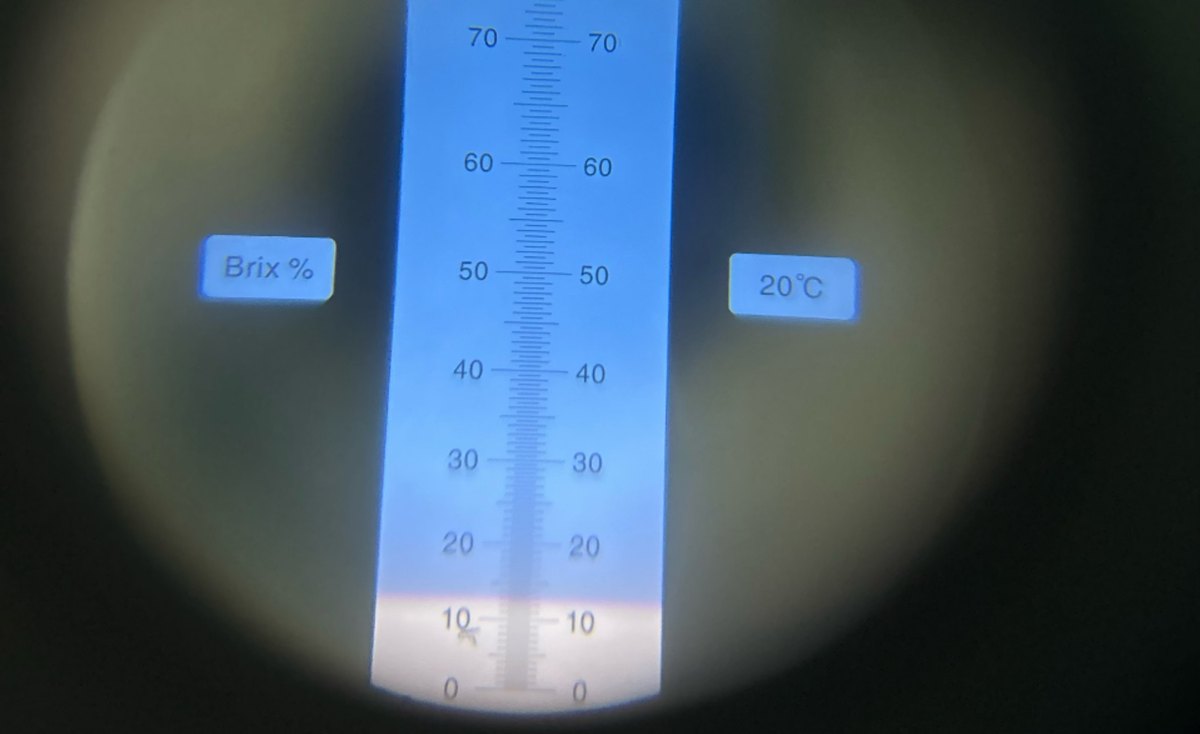
The knob that actually controls flavour in this category is the ratio of sweetness to acid, not sweetness alone. On our bench we target roughly 15 to 25 brix per unit of acid, low end for citrus-forward drinks and high end for mango and tropical bases. An acid-forward drink with too little sugar does not read as sophisticated, it reads as sour. The same drink with the acid balanced reads as crisp.
Ice complicates all of it. A full cup of ice dilutes the drink 25 to 35 percent from first sip to last. So the recipe targets roughly 10 to 13 brix in the mouth at the start and is built about 20 percent above that in the shaker.
The classic failure here is syrup poured over ice. Syrup is denser than tea, it dives to the bottom, and the customer's first sip is bland while the last is syrup. If your reviews say “too sweet at the bottom”, nothing is wrong with your ratio. Your pour order is wrong. The syrup range we cut for this category is specified on density as well as on sweetness, which is why two syrups at the same brix can behave nothing alike in a layered build.
What to do:
- Balance brix against acid, not against habit. Use the meter, not the memory.
- Calculate jam sugar and syrup sugar in one column, then set the target.
- Build in dilution compensation, but cap it. Over-building sweetness to survive the ice just delivers syrup by the last sip.
- Shake or stir to a homogeneous pour, and never let syrup meet ice first.
Part 5: The fruit milk series, taken apart
A layered fruit milk drink is architecture. A mixture is what you get when you pour everything at once and hope.
The series the market calls fruit milk, with mango pomelo sago as its founding example, separates into three jobs. Each layer is doing something the others cannot.
Table C. Layer map for a fruit milk drink
| Layer | What goes in | Job it does |
|---|---|---|
| Bottom | Jam and pulp, sometimes crushed fresh fruit | Colour, acid, visible evidence, and the density anchor |
| Middle | Chilled tea, sometimes built as a light slush | Body, and the buffer zone that keeps acid and protein apart |
| Top | Milk or creamer, poured last down the side of the glass | Fat, smoothness, and the marble that gets photographed |
The bottom layer carries the highest solids in the cup. The middle layer is the skeleton and the buffer. The top layer is the lowest density and goes in last, down the side of the glass, so it rides over the tea and draws the marble.
Two structural routes, and you should choose one on purpose.
The uniform route. Stabilise the milk base for acid, shake everything together, serve a homogenous creamy drink. The threshold lives in the formulation: your creamer or milk base has to survive the fruit's pH at your dilution. Get that right and the drink is forgiving, consistent, and travels well in delivery.
The layered route. The tea layer acts as a buffer, the milk never meets the acid directly, and the build depends on density arithmetic and pour discipline. It photographs better and it sells the craft. It also demands an SOP: fruit and jam first, ice, tea, then milk down the side, no shortcuts.
The layered route has a clock. The marble holds best inside about 30 minutes. By 45 minutes the layers are drifting, and if that drink is in a delivery bag, most of that window was spent in traffic.
If the product has to survive delivery, choose the uniform route or lock the layers with a low-dose hydrocolloid. If the product lives on the counter and in the photograph, layer it, and accept the clock.
The slush build is the third option. Freeze the whole drink into one phase and every stability problem in this article disappears, along with the layers and half the aroma. That is a real trade, not a hack.
Where this matters for buyers
Most of what sits on our R&D bench in 2026 is not a new flavour. It is an acid-tolerant creamer base that holds a mango drink at pH 3.6, a beverage jam with the pH and brix pinned so the tenth container behaves like the first, and a syrup cut for density as much as for sweetness. A year of formula work looks like that.
If one of the four systems above is where your drink keeps failing, the next step is small. Send us the fruit, the target market and the label pressure you are working under, and we will tell you honestly which of the three milk routes your product should take. Custom formulation and OEM or ODM work to your recipe is our normal way of operating, and we train your team on preparation so the texture survives the counter.
Specification sheets for the creamer, jam and syrup ranges behind this article are on the product pages. If you would rather start from the drink than from the ingredient, send the recipe you are running now through the contact form and we will tell you which system is out of balance.
Frequently asked questions
Why does milk curdle in fruit tea?
Because acid strips the electrical charge off casein, the main milk protein. At milk's normal pH of 6.6 to 6.8 the casein particles repel each other and stay suspended. As the drink acidifies toward pH 4.6, that repulsion disappears, the proteins clump and rise as curd. Most fruit purees sit between pH 3.0 and 3.8, well below the threshold. The fix is not a better milk, it is a different system: a stabilised milk base, a creamer, or a build order that keeps acid away from warm protein.
Can I use fresh milk in a mango fruit tea?
Yes, if three conditions hold. The mango must be ripe and low-acid, closer to pH 4.5 than 3.5. Everything must be cold, with the fruit added after the milk and tea are chilled. And you have to re-check when the season turns, because the same cultivar can move close to a full pH unit between months. If any of those three is unreliable in your kitchen, use a stabilised base instead. Guessing on mango is how a menu item becomes a complaint.
How strong should the tea be in a fruit tea?
One notch lighter than your plain milk tea base, and built with ice dilution in mind. On our bench that is a green or light oolong near 1:50 at around 70 degrees, with the recipe compensating for 25 to 35 percent dilution from a full cup of ice. Stronger than that and tannin buries the fruit, dries against the milk protein and turns bitter as the drink cools.
What brix should a fruit tea be served at?
Roughly 10 to 13 brix in the mouth on the first sip, which means building the shaker about 20 percent higher to survive the ice. Balance is the real target: we work at 15 to 25 brix per unit of acid, lower for citrus and higher for tropical fruit. And count the sugar that arrives through the jam, because at 55 brix a jam contributes more than half its own weight in sugar.
Why does my fruit milk tea separate after ten minutes?
Two different failures look similar, so diagnose before you reformulate. If you see curd, grainy particles or a skin, the drink is sitting too close to pH 4.6 and the reaction is accelerating as the ice melts and the cup warms. If you see clean layers drifting apart with no particles, that is density and time, not protein. The first is a formulation problem. The second is a build order and stabiliser problem.
What is the correct layer order for a fruit milk drink?
Fruit and jam at the bottom, then ice, then the chilled tea, then the milk last, poured down the side of the glass. The tea layer is what keeps acid and protein apart, and the pour is what creates the marble. Never send milk straight into an acid layer. And serve it inside about 30 minutes, because the structure is a presentation, not a shelf-stable format.
Operator's checklist for the next two quarters
- Measure the pH of every fruit layer you use, and re-measure when the season turns.
- Write the milk route on every recipe card: fresh, stabilised or creamer. No ambiguity at the bar.
- Dissolve milk into tea first, chill, then add acid. Never acid into warm milk.
- Count jam sugar and syrup sugar in the same column of the same sheet.
- Set brix targets at first sip, and build for 25 to 35 percent ice dilution.
- Run fruit tea bases one notch lighter than milk tea bases, under about 75 degrees.
- Write the pour order on the card for layered drinks, and train it until it is boring.
- Test every new recipe twice: once in the lab, once in the worst kitchen you operate.
Sources and data notes
Figures here are reference ranges, not specifications. Fruit acidity moves with cultivar, origin, ripeness and season, so verify per lot before you commit a recipe.
- Casein isoelectric point and acid-induced aggregation: standard dairy chemistry references; acidified milk beverage stabilisation literature covering high-methoxyl pectin, CMC and PGA as protective colloids.
- Fruit pH ranges: fruit processing industry reference data, cross-checked against typical beverage formulation practice.
- Jam brix and pH: beverage jam specifications as commonly traded between suppliers and beverage manufacturers; verify against the actual supplier sheet.
- Dilution and brix targets: our internal bench practice for full-ice builds, offered as starting points rather than universal constants.
About the author
Yingcai Yang, Director at Shenzhen Cha Xiaoleng Food Co., Ltd. Sixteen years in tea drink ingredients, working with importers, distributors and chain operators in more than 50 markets.